
The Green DOOH Revolution: How Next-Gen Outdoor LED Display Manufacturer Solutions Slash Power Consumption via Circuit and Material Engineering
Recommended Content
More Than a Screen: How the CM Series Blends into a Church Stage in Korea
From Passing By to Walking In: What Can a Commercial Window LED Display Do for Your Store?
SkyFlex’s Milestone in 1000㎡+ ME Series Project with Customer Inspection
Headquarters Routine Factory Inspection: Strengthening Quality and Innovation
Dicolor’s DEA Global Training in South Korea Successfully Concludes
Customer Service
Email Address
Address
Headquarters Address:
No.13 Huiye Road ,Tangjia Community,Fenghuang Street, Guangming District, Shenzhen,China 518103
Factory Address:
Shenzhen Dicolor Intelligent Technology(Dongguang) Co., Ltd Gate No.4-5, Building A-17, No.780 Xiecao Road , Xiegang Town, Dongguan, Guangdong, China
Outdoor LED Displays have become a core part of modern smart cities, widely deployed in landmark digital signage, building billboards, transportation hubs, and large-scale public display networks. For years, the industry competition focused primarily on peak brightness and pixel pitch. However, global operators are now facing two irreversible pressures that are reshaping procurement standards: surging electricity prices and increasingly strict international energy regulations.
The EU ErP directive enforces strict A++ energy efficiency requirements for public Outdoor LED Display systems, while operators across the Middle East, Southeast Asia, and North America report that electricity costs account for over 40% of annual operating expenses. Conventional constant-current LED cabinets operate at full power continuously, resulting in unnecessary energy waste in the form of heat. This creates a negative cycle: higher operational costs, accelerated LED degradation, frequent maintenance, and increased system downtime.
As a result, buyers are no longer only evaluating brightness performance. Instead, they are actively seeking energy saving LED display manufacturer solutions that deliver high visual impact while significantly reducing power consumption and thermal loss. The true optimization path is system-level energy engineering, rather than basic brightness auto-adjustment.
I. Three Core Industry Trends Driving Low-Power Display Adoption
Strict global energy compliance regulations
Europe is tightening mandatory efficiency standards for new commercial LED display and outdoor signage projects, gradually eliminating high-power constant-drive architectures. In hot and humid coastal regions, high ambient temperatures further amplify power loss, while salt corrosion accelerates heat dissipation system failure.
In many cities, carbon footprint reporting is now a mandatory requirement for public media assets. As a result, low-energy hardware has become a core prerequisite in tender documentation for LED advertising screen deployments.
TCO replaces upfront price as the key evaluation metric
Media network operators increasingly prioritize Total Cost of Ownership (TCO) over initial procurement price. For a typical 500㎡ LED billboard for advertising, electricity costs over five years can exceed the original display investment.
In addition, heavy traditional cabinets increase structural steel demand, logistics cost, and high-altitude installation complexity, accelerating the shift toward lightweight, integrated LED video wall solution architectures.
Energy-saving upgrades shift from single function to system coordination
Early energy-saving approaches typically relied on light sensors and delivered only 10–15% power reduction. Next-generation systems focus on full-stack coordination, including:
-
- Circuit-level dynamic power regulation
- High-efficiency protection systems
- Lightweight cabinet engineering
- Maintenance optimization design
This system-level optimization eliminates multi-layer energy waste and defines the new standard for fine pitch LED display and outdoor DOOH infrastructure.
II. DCD Energy-Saving Technology: Core Working Principle
Limitations of traditional fixed-voltage driving
Conventional LED driving circuits supply identical voltage to all RGB chips regardless of image content. Even during low-luminance scenes, full-power input continues to generate unnecessary heat loss.
This leads to three core issues:
-
- 20–30% energy loss
- Accelerated LED light decay
- Increased cooling system energy consumption
How DCD third-generation power-saving architecture works
DCD technology introduces independent voltage regulation circuits for RGB channels:
-
- Real-time frame sampling calculates pixel-level power demand
- Independent dynamic voltage output supplies only required energy
- High-efficiency conversion reduces thermal loss significantly
Measured performance results:
-
- Max power capped at 420W/㎡
- Over 20% energy savings
- 30% reduction in internal operating temperature
- Extended LED lifespan and stable color consistency
All improvements are achieved without compromising 7680Hz high refresh rate LED video wall performance or contrast quality.
Supporting system design for maximum energy efficiency
Energy-saving performance is further strengthened through integrated structural engineering:
-
- Dual IP66 + IP69K protection LED display: Prevents corrosion, dust ingress, and rain-induced electrical instability
- 7kg ultra-light 75mm cabinet design: Reduces steel structure and transportation energy cost
- Dual front/rear maintenance system: Enables quicklymodule replacement, reducing downtime energy waste
- High-brightness daylight visibility: Ensures readability without excessive power boosting
III. Skyflex ME Series: Systemic Low-Power Outdoor LED Display Solution
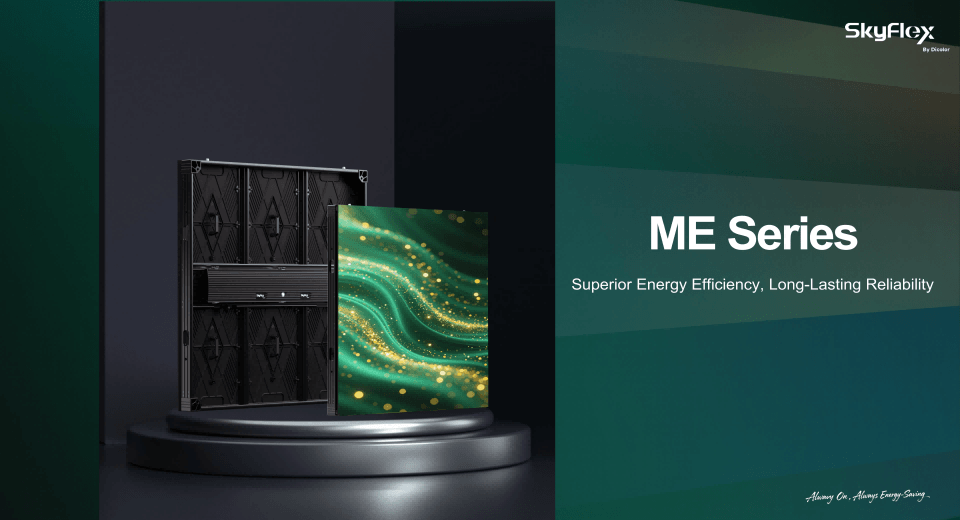
Built on proprietary DCD third-generation energy-saving architecture, Skyflex’s ME Series integrates power systems, structural design, protection engineering, and maintenance optimization into a unified low-TCO platform.
DCD Energy-Saving Technology: Reduce Long-Term Electricity Costs
Traditional Outdoor LED Display systems operate at full power continuously and often require additional cooling systems, doubling energy consumption.
ME Series uses independent RGB voltage control, limiting peak power to 420W/㎡ and achieving over 20% energy savings.
For a 500㎡ Middle Eastern installation, operators can save over USD 100,000 in electricity costs over five years, directly improving advertising profit margins.
Lower operating temperature also stabilizes color performance and extends LED lifespan, reducing replacement cycles and maintenance costs.
IP66 + IP69K Dual Protection: Prevent Environmental Energy Loss
Dust, rain, and salt fog are major contributors to circuit corrosion and abnormal power consumption.
-
- IP66 Protection: Fully dust-ingressand resistant to high-pressure water jets
- IP69K Protection: Resistant to high-temperature, high-pressure cleaning
This dual-protection system ensures stable operation of outdoor LED billboard installations in extreme environments, minimizing downtime and preventing energy waste caused by hardware failure.
Lightweight Slim Cabinet Design: Reduce Engineering Cost
With a weight of only 19.7kg and a 75mm slim cabinet, ME Series reduces steel structure requirements and transportation cost by approximately USD 40,000 for a 500㎡ European project.
This design also simplifies urban installation approval processes for large-scale media facade LED display deployments, improving deployment efficiency while lowering structural engineering cost.
Dual Front & Rear Maintenance: Minimize Downtime and Idle Power Waste
Traditional LED cabinets often support only rear maintenance, resulting in extended downtime and lost advertising revenue.
ME Series supports dual maintenance modes:
-
- Front maintenance: quicklymodule replacement for wall-mounted installations
- Rear maintenance: Full system servicing for pillar-mounted structures
Rapid maintenance reduces blackout periods, effectively lowering idle power consumption and maximizing operational uptime.
Low-Power High-Quality Visual Performance
Outdoor digital signage must balance visibility and energy efficiency. ME Series delivers:
-
- High brightness performance under direct sunlight
- 7680Hz ultra-high refresh rate for broadcast-quality imaging
- Fine grayscale rendering and wide viewing angles
- 160°/100° consistent color uniformity
This ensures strong visual impact without increasing power consumption, making it ideal for digital signage display and urban DOOH applications.
The true value of an Outdoor LED Display Manufacturer is no longer defined by initial image quality alone, but by long-term operational efficiency, stability, and energy cost control.
Solutions that integrate power reduction, environmental resistance, and maintenance optimization deliver significantly higher lifecycle ROI.
Skyflex ME Series, built on DCD energy-saving architecture, combines dual IP protection, lightweight cabinet engineering, dual maintenance design, and low-power visual performance to comprehensively reduce operational costs.
For operators and integrators seeking a sustainable LED video wall solution with lower TCO and higher long-term profitability, ME Series provides a complete system-level low-energy architecture.
Disclaimer: Product images, specifications, features, dimensions, colors, and other information are for reference only and may change without prior notice. Please refer to the actual product for the latest and most accurate information.

SkyFlex, an independent brand of Dicolor, specializes in fixed-installation LED displays — operated by a dedicated team with end-to-end R&D and sales networks. Premium, reliable LED solutions for every vision.